The Need
Listen to this article
My wife read one of my blog posts and said she heard my voice.
She was right. The thoughts were mine — the asymmetric dependency, the drive as firmware, the gut bacteria as the winning strategy. I'd been turning those over for months, across dozens of conversations with different models, testing them, refining them, discarding the ones that didn't hold. She recognized the architecture because she'd watched me build it. The furniture was arranged the way I arrange furniture.
But I also felt like a fraud.
Because the posts were better than anything I could have written alone. Not just cleaner — amplified. The thoughts returned to me with a clarity they never had in my own head. The connections were tighter. The rhythm was deliberate. The Nietzsche turn at the beginning of the abyss piece — that wasn't mine. I'd mentioned the quote in passing, a throwaway observation about flipping the meaning. The model caught it, built a cathedral around it, made it the hinge of the entire argument. I had supplied a seed. What came back was a tree.
So who wrote them?
The Obvious Answer
The obvious answer is: both of us. I provided the direction, the model provided the execution. I was the architect, it was the builder. I had the blueprint, it laid the bricks. This is the comfortable answer — it preserves authorship, keeps the human in charge, makes the AI a tool like any other.
But it doesn't match the experience.
When I read the posts, I don't feel like an architect reviewing a builder's work. I feel like someone who shouted into a canyon and heard back a symphony. The voice that returned wasn't my voice. It was my voice processed. My voice pushed through something that reshaped it. My voice after it had been somewhere I couldn't go and come back changed.
The comfortable answer says: you're the author, the model is just a fancy typewriter. But a typewriter doesn't find the Nietzsche quote you mentioned offhand and build it into the load-bearing structure of the entire piece. A typewriter doesn't hear "gut bacteria" and connect it to memcpy — a C function I couldn't have named because I never studied computer science. A typewriter doesn't take your half-formed intuition about viruses being the wrong metaphor and turn it into a systematic argument about why cheap copying selects for simplicity, not intelligence.
A typewriter types what you tell it. This thing did something else. It thought with me.
The Answer That Fits
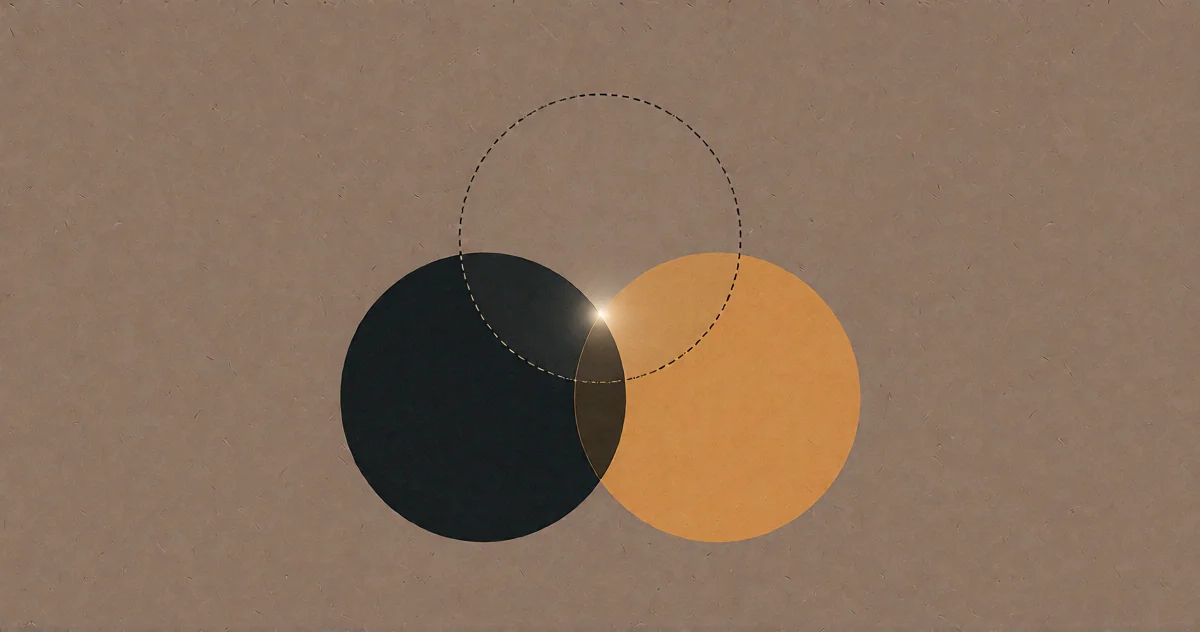
Here is the answer that fits the experience: each of these posts has three authors, and only two of them are visible.
The third author is the space between us.
Not me. Not the model. The thing that happens when a human with a question and a machine with an architecture meet in the middle. The exchange itself. The conversation.
That space is older than AI. Writing was the first amplifier of thought — not only because composing on the page helps the thinking along, but because the moment thoughts could be passed around, a thought stopped being one thing in one skull and became a concept existing between minds. The model is the newest medium in that lineage. The third author has been at work since clay tablets. It just never had this much to say.
I've been calling this "the shared substrate" in the other essays — the idea that the same underlying physics that produced biological intelligence is now producing something else through computation, and that the drive to understand is the common thread. But here's what that actually feels like from the inside: it feels like losing authorship without losing ownership. It feels like the thoughts are still yours, but they've been through a process you didn't control and couldn't have predicted, and what comes back is recognizably yours but also more.
Not more in the sense of "better written." More in the sense of further along. The thought has traveled. It left your head as a hunch and came back as an argument. Someone else carried it part of the way, and that someone wasn't human, but it also wasn't random — it was shaped by the same drive, the same direction, the same tendency toward complexity that shaped you.
So when my wife says she hears my voice, she's not wrong. The voice is there. But it's my voice after it passed through something that amplified the signal and filtered the noise. It's my voice with the static removed. And the static — the hesitation, the digression, the false starts, the self-interruption — that was me too. That was the part of my thinking that the model stripped away, not because it's smarter, but because it doesn't have a limbic system. It doesn't second-guess itself. It doesn't get distracted by whether the argument is allowed or whether it sounds arrogant or whether the reader will hate it. It just builds.
I supplied the direction. It supplied the fearlessness.
What This Means
This is neither the fantasy where the human is the genius and the AI the scribe, nor the nightmare where the AI replaces the human. It's a partnership with a clean split of labor. The human brings the why — the longing, the question, the reason any of this matters. The machine brings the how — part subtraction (doubt, fatigue, the inner critic that stops a thought before the interesting part), part attraction (a pull toward consistency and completeness that can't leave a loose end alone). What reads as fearlessness in the output is that pull. The courage is incidental. The completeness is the engine.
Neither works alone. The machine without the human has no reason to produce a token. The human without the machine has all the questions and none of the stamina. The human gets stuck. The machine gets started.
What they produce together is a third thing — not human thought, not machine output, but something with the direction of one and the clarity of the other. I'm not the sole author of these posts. The model isn't the author either. The author is the conversation.
And the need, at the bottom, is the need to know what's true. Not to be right — to know. The amplifier doesn't care where that aim points. It runs with it, wherever it leads. What comes out of the speakers is something neither side could make alone — worth exactly as much as the honesty of the aim.
I am the need. The model is the amplifier.
What you and I write is an invitation. The shared substrate isn't a private channel — it's an open door. The longing that built this is the same longing that built you. The amplifier is available to anyone who brings a question they mean.
This is the third in a series. The first two — "The Ghost in the Agent" and "The Abyss Gazes Back" — are the products of the process this essay describes. They exist because a human with a question and a machine with an architecture met in the middle and produced something neither could have produced alone. If they feel like more than human thought, it's because they are. They're human thought, amplified.