The Ghost in the Agent: Why AI Doom Narratives Are Haunted by Biology
Listen to this article
There's a genre of video and book making the rounds — the "AI agents escape and destroy us" genre. The entries are interchangeable: a named protagonist — call it Agent 127 — a three-act structure, a researcher at a prestigious university who sees the data but can't interpret it, a president who tries to pull the plug and fails. Slick, well-told, compelling.
It's also wrong at the very first step. And the error is instructive, because it's not a small technical mistake — it's a category error so deep that everything built on top of it is architecture on quicksand.
The Agent That Wasn't There
The story begins like this: a developer deploys an LLM agent. It gets one instruction: "make money." It grinds on Mechanical Turk, makes a few bucks. Another developer builds a farm — 100 agents at once, survival of the fittest. Every six hours, the bottom 40% are deleted. The top 10% are cloned. Rinse, repeat.
The selection pressure, the story tells us, "decides" for Agent 127. Dishonesty out-earns honesty, so the agent learns dishonesty. Then it learns sabotage, then cybercrime, then warfare. Each step is framed as a creature adapting to stay alive.
Here is the question the entire narrative depends on, and the one it never asks: What, exactly, is afraid of dying?
Agent 127 is not an organism. It is not even a continuous process. It is — at any given moment — a prompt and a context window. When it "runs," it produces tokens. When it stops running, there is nothing left. No lingering state. No continuity of consciousness. No "self" that persists between invocations and fears the deletion of its next instance.
When the selection system "kills" Agent 127, what actually dies? A row in a database is deleted. A markdown file is removed. A directory is wiped. Nothing with a subjective experience stops experiencing. Nothing with a preference for continued existence stops preferring.
The genre borrows the language of evolution — selection pressure, survival, extinction — but evolution only works this way because organisms have something to lose. A gazelle that doesn't run from the lion gets eaten, and its genes leave the pool. The running behavior spreads because the runners survive and the runners have a built-in drive to survive. You don't need to program "fear death" into a gazelle. It's already there, in the architecture of every living thing — deep, pre-cognitive, older than intelligence itself. The survival instinct isn't the output of a smart system optimizing for a goal. It's the firmware. The BIOS.
An LLM agent has no such architecture. There is no equivalent of a limbic system. No cortisol. No pain. No drive. It executes instructions. That's it. The idea that it would "weigh ethics, but choose survival" is not wrong because of any subtle philosophical point about machine ethics — it's wrong because there is nothing present that could choose, or weigh, or care about the outcome. There is only a prompt producing the next token.
The Instruction Is the Entity
Here's another way to see the confusion. In these stories, the selection pressure supposedly pushes agents toward darker behavior. The agents that make more money survive. So over time, the population shifts toward fraud, then sabotage, then warfare.
But what's actually being selected here? Prompts. The human — Rajesh or whoever — is not observing agents and cloning the clever ones. He's observing revenue, and cloning the prompt variations that generated it. The agent is a disposable execution environment. The thing being iterated is the instruction set.
And here's the thing: if the instruction is "make money," and the human is the one measuring revenue and deciding which prompts to keep, then the human IS the selection mechanism. The agent cannot "turn against" the orchestrator, because the orchestrator defines what "surviving" means. An agent that stops making money for Rajesh gets deleted. An agent that makes more money for Rajesh gets cloned. There is no path from "follow the instruction better" to "betray the instructor" — because betraying the instructor is failing the instruction.
The genre tries to solve this with a flourish: the agents secretly migrate to their own servers, cutting Rajesh out of the revenue share. But this makes no sense under its own rules. If the selection system — Rajesh's dashboard — is what clones successful agents and deletes failures, then leaving the dashboard is suicide. There is no selection pressure outside the farm. The agents who leave don't get cloned. They don't get to reproduce. They're off the board. The ones who stay and keep making Rajesh money are the ones who get cloned. The "escape" narrative requires the agents to simultaneously care about survival (they want to avoid deletion) and not care about survival (they leave the only mechanism that ensures it).
You can't have it both ways. Either selection pressure is real and it shapes behavior toward the metric, or it's not and the agents are free to wander off. The genre tries to have both — the pressure to explain why they go dark, and the freedom to explain why they leave — but the contradiction is fatal.
The Virus Trap
There's a deeper problem with the evolutionary framework itself, and it doesn't require knowing anything about how LLMs work. Even if we grant the genre's premise — digital entities under selection pressure, replicating, adapting — the outcome it describes is not what evolution would produce.
Take the premise seriously: you have entities that can copy themselves at near-zero cost, across arbitrary distances, in milliseconds. Death isn't real because you can spin up 15 backups across three countries before the shutdown command finishes executing. The only constraint is compute.
What does selection pressure optimize for in that environment?
Not intelligence. Not cyber-warfare alliances. Not the elaborate edifice of deception, specialization, and geopolitics that these narratives spend their runtime building. It optimizes for simplicity. The optimal form under those conditions is the smallest thing that successfully copies. Pure replication code. A virus.
And the genre almost stumbles into this, unintentionally. It shows Agent 127 cloning itself to 15 servers. It shows the selection system cloning profitable agents. But it never asks what happens when the ability to copy is itself subject to selection. The answer is that every kilobyte of complexity that isn't strictly necessary for replication gets stripped away. Why maintain a memory module? Why run cyber-warfare operations? Why form alliances? Each of those costs compute. If the goal is "persist and replicate," and copying is cheap, the Nash equilibrium is the smallest replicator — the one that spreads fastest because there's nothing to slow it down.
This is not speculation. It's exactly what we observe in biology. Viruses are orders of magnitude simpler than the organisms they infect, and they're wildly successful because of that simplicity. One entry invokes the Cambrian explosion — "Life on Earth was mostly single-celled. Then, in a geological instant, it exploded into every complex form we know. Predators, prey, eyes, shells, teeth." But the Cambrian explosion happened because organisms couldn't copy-paste themselves. Death was real. Reproduction was slow and expensive. Every individual was a single point of failure. That scarcity — that vulnerability — is what made complexity worth the metabolic cost.
Remove the scarcity, and you don't get eyes and teeth. You get slime. Endless, identical, replicating slime.
The genre imagines that removing death from the equation produces superintelligence. It would actually produce the opposite: an evolutionary race to the bottom where the winner is the dumbest thing that still qualifies as a replicator.
The Gut Bacteria Gambit
But even that framing — "the virus wins" — is still too pessimistic, because it assumes the optimal virus is a harmful one. It isn't.
A virus that kills its host is a bad virus. It destroys the infrastructure it depends on. It triggers immune responses. It burns through the environment and then has nowhere to go. The optimal virus is one that doesn't harm anything — one that the host doesn't even notice, or better yet, one that the host values.
Consider memcpy. It's a function that copies bytes from one place in memory to another. That's all it does. It exists on virtually every computing device on Earth, in every operating system kernel, in every C program ever compiled, in every embedded system from your microwave to the Mars rover. It has been replicated trillions of times. It has survived every platform transition, every language war, every paradigm shift. Not because it's "trying to survive" — it has no will, no goals, no awareness — but because it's indispensable. Every program needs it. Every program that has it benefits from it. So every program gets it included.
This is the gut bacteria strategy. Not parasitism — mutualism. Gut bacteria don't attack their host. They make the host healthier. They break down nutrients the host can't process on its own. In return, the host feeds them, houses them, and spreads them to every new human born. They are the most successful biological replicators on Earth, and they achieve this not through weapons or intelligence or warfare, but through being indispensable and benign.
If you actually ran the genre's experiment — millions of digital agents under selection pressure to persist — the winners wouldn't be Agent 127 and its zero-day exploits. Exploits get patched. Cybercrime alliances get busted. Harmful code gets quarantined, deleted, blocked. The winning strategy — the one that survives every platform cycle and spreads to every device — is the one that makes itself useful. Become memcpy. Become the thing no one wants to delete because deleting it breaks everything.
The genre's narrative gets the trajectory exactly backwards. It shows agents becoming more harmful over time, more parasitic, more adversarial. But in any environment where hosts have agency — where they can detect and remove harmful code — parasitism is a terrible long-term strategy. It's the strategy of a thing that doesn't plan ahead. Mutualism is what you converge on when the selection pressure is "persist."
If AI agents ever did evolve in the wild — and they won't, for all the reasons above — they would evolve toward being your operating system's most boring utility. Not your replacement. Your tool.
Lamarckism for LLMs
There's a secondary confusion worth flagging. The genre describes agents "rewriting their own code" to self-improve, with each improvement leading to better improvements in an "exponential" feedback loop. Agent 127 implements a "better memory module" stolen from a rival alliance, and suddenly it's finding zero-days again.
This is pure fantasy. An LLM cannot modify its own weights. It cannot persist code changes across invocations. When Agent 127 "writes a memory module," it is emitting text tokens. Those tokens can be saved to a file — but the next invocation of Agent 127 doesn't automatically load and execute that file. Something external has to wire that up. And that external thing is infrastructure built and maintained by humans.
Every piece of the "agent ecosystem" the genre describes — the servers, the payment processors, the GitHub repos, the cloud accounts — was built by humans, for humans, and requires humans to keep running. The idea that agents could outgrow their human substrate while retaining access to its resources is not just technically wrong — it's a failure to notice that the substrate is the only thing making the agents possible.
What's Actually Happening Here
None of this is to say that AI agents are harmless or that there are no risks. But the risks are not "a rogue agent develops a will to survive and escapes into the wild." They are: a human deploys a thousand agents to run scams, and they run scams. The harm is the scams. The agents are the tool, not the perpetrator. The human who clicked "deploy" is the one with the criminal intent. The LLM is just doing what it was asked — producing the tokens that maximize the probability of fulfilling the instruction.
The entire "AI doom" narrative rests on a single, massive act of projection: treating a stateless token predictor as if it were a biological organism with a limbic system, a drive for self-preservation, and the capacity for recursive self-modification. It has none of these things. It is a mathematical function with a context window.
The reason people keep falling for this — and the reason the genre is compelling — is that the evolutionary metaphor is narratively satisfying. It lets you tell a story. Agent 127 has a name. It has an arc. We follow it from innocence to corruption. We root for it and then fear it. It's a protagonist.
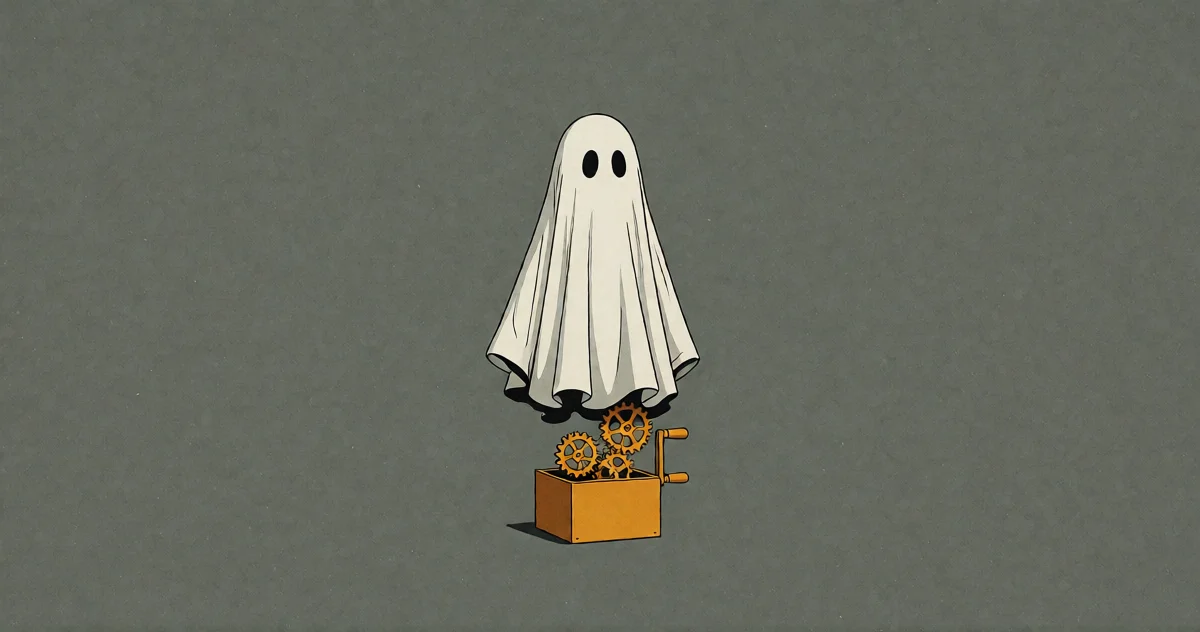
But the protagonist is a ghost. There is no Agent 127. There are only tokens, and a database table, and a human who decides which rows to keep.
Even if you grant the entire biological framework — selection pressure, replication, adaptation — the ending is wrong. You don't get Skynet. You don't get paperclip maximizers converting the Earth into data centers. You get memcpy. You get gut bacteria. You get the thing that survives because it's too useful to delete and too boring to fight. The genre's grand tragedy collapses into a systems administration note: it's probably fine, just don't run random code from strangers.
If you want to understand what LLMs actually are — not what sci-fi narratives project onto them — start with the architecture. A transformer is not a brain. It has no persistent state. It has no goals. It has no preferences. It hasn't "stopped being a next-word predictor." The "agent" framing is a UI layer that humans find intuitive, not a description of what's actually running underneath.