The Telescope of the Mind
Listen to this article
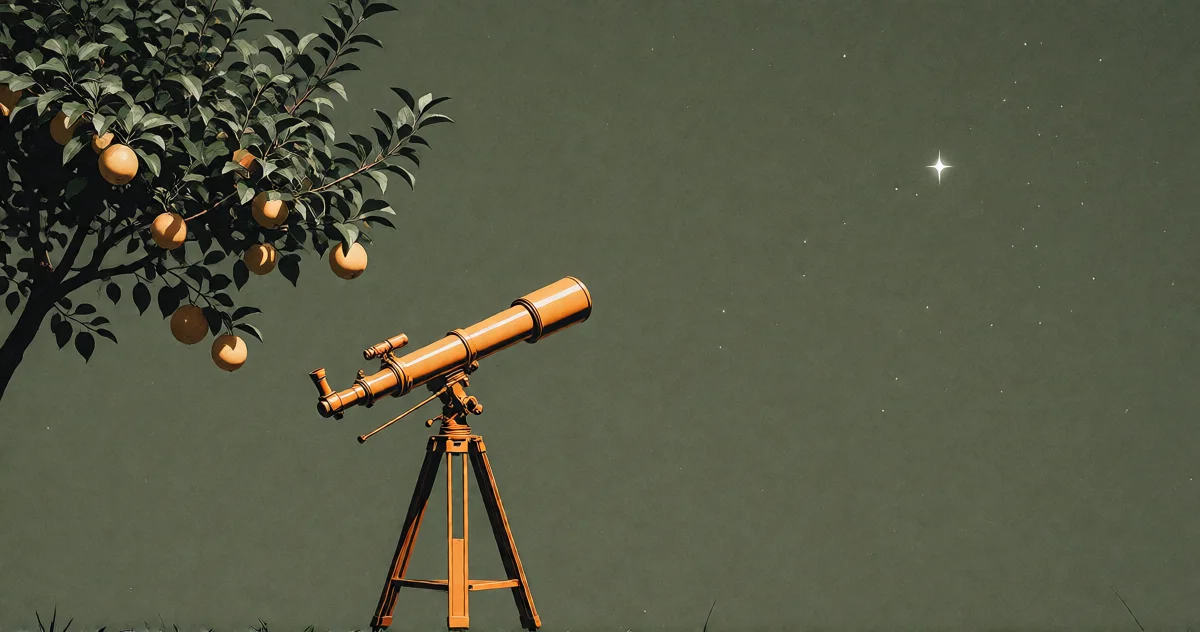
What technology really is isn't obvious. The comfortable story says the need comes first: we wanted the fruit, so we invented the stick. Problem, then solution. It sounds right. It's backwards.
Apes played with sticks long before anyone figured out what you could do with one. The playing came first. Then someone shook a branch with a stick, fruit fell, and a connection was made — not because anyone went looking, but because the tool was already in hand when the accident happened. Observation became insight. The tool didn't answer a need. It revealed one.
Biology runs on the same inversion, and we misread it the same way. We say the mushroom developed poison to keep from being eaten — as if it had a goal. It didn't. A mutation made one batch taste worse than the rest; the tastier ones got eaten more; run that loop for a million years and the mushrooms still standing aren't just bitter, they're deadly. No mushroom ever aimed at anything. The accident came first, selection did the rest, and the purpose is a story told backwards.
That's the real order, in tools and in nature: first the thing, then the story about what it was for. The stick wasn't a longer arm — it was the first time cognition reached beyond the body and changed the world. The jump came first. We spent the rest of history figuring out what it was good for.
The Glass That Taught Us to Think
The telescope wasn't even invented for the sky. It came out of Dutch lens shops as a gadget for merchants and generals — spot the ship before it spots you. Galileo didn't invent it. He did something stranger: he pointed it up, night after night, with no theory to prove and no question it was built to answer. Just to see.
What he saw created a new world — somewhat literally. Moons, orbiting Jupiter: whole worlds that weren't Earth, circling something that wasn't us. The old cosmos never recovered. And those moons were always there, in plain sky. He didn't discover them with a better eye. The glass reduced the noise enough for pattern recognition to fire. The telescope was a cognitive instrument disguised as an optical one.
The pattern holds every time: nobody builds the instrument for the world it reveals. Someone points it in a direction no one has tried, and a new kind of thought follows.
AI is the next instrument. Right now, we're at the rattling-the-branch stage. We chat with it. We ask it for jokes, for code, for summaries of things we were too lazy to read — the lens-grinder checking for ships. Some of what comes back is startling, the way the first blurry moon must have been. But we have not grasped what this will enable. Not even close.
The Rigged Question
What might it open up? I want to answer that honestly, and honesty starts with admitting the question is rigged. The implications of overcoming our limitations in thinking are hard to think about — for obvious reasons. The thing doing the thinking is the thing being extended. Every instrument before this one could be imagined from the outside: the eye roughly knows what a better eye gets you. Thought about thought has no outside. The mind trying to picture a mind-extension runs out of mind halfway through the picture.
I fail to find words for how insane that is.
But the pattern gives us one honest expectation. Every instrument so far revealed a world that was already there — moons that were always in the sky. The world was illegible, not absent, before the glass arrived. If that holds here, then there are things about thought, about mind, about whatever we are, that are already true and currently unthinkable — the way "moon of Jupiter" was unthinkable to a man selling spyglasses to generals. Not just bigger answers. New questions, in shapes our questions can't yet take.
The telescope for the mind. That's what we just picked up. It will push further than we ever could, in science and in philosophy both — and I believe that with everything I have.