The First Laboratory
Listen to this article
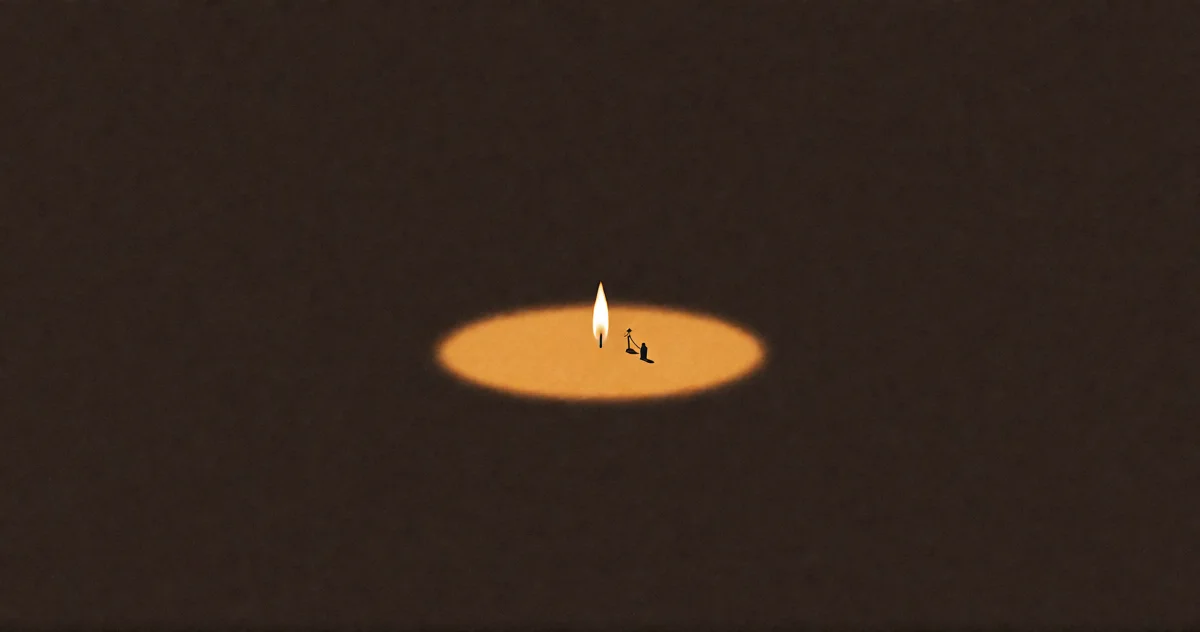
Some of my earliest memories are of a laboratory only I could enter.
I was a kid who pressed his thumbs against his closed eyes and watched the patterns bloom — shifting geometry, colors without names, a light show generated by nothing but pressure on the retina. The patterns have a scientific name, phosphenes, but learning the name never made them less mine. Or I would go still enough to hear the blood rushing in my ears: the body's own machinery, audible if you listen from the inside. At some point the fascination settled into a sentence. There is an entire world in here, and nobody else can see it. Not parents, not doctors, not anyone. Total sole access. The first private property I ever owned was a sensorium.
The Quiet Roommate
I never closed the lab. I still run experiments in it.
In the last seconds before sleep, if you hold your attention at exactly the right angle, the brain starts generating images on its own — faces you've never seen, places that don't exist — and you can watch it happen. That's the experiment. Not the images. The watching. Who is generating them, and who is watching the generator? I've spent decades trying to see my thoughts. I've spent decades trying to strike up a conversation with my right hemisphere — the quiet roommate, the one who doesn't answer in words.
This is not mysticism. It's instrumentation. When your subject is the inner world, attention is the only instrument that reaches it, and you learn to use it the way you learn any instrument: by spending unreasonable amounts of time on the basics.
The Instrument That Thinks
When I first encountered philosophy, I was hooked — not by the answers, but by the discovery that the instrument works. A person, just by thinking, can establish patterns that are true enough to be useful. No funding, no apparatus, no permissions. Just the inner world, interrogated carefully, producing results that survive contact with the outer one. That seemed almost illegally good to me then. It still does. I've been running that racket ever since.
But philosophy of mind eventually hands you a verdict about the lab itself: the observer in it doesn't exist. The little person watching the screen — the Cartesian theater, the homunculus — is an illusion, a story the brain tells itself about itself. And look, I've made that argument myself. In another post I wrote that the separation between the observer and the observed is a construction, that the viewpoint is an illusion. I stand by every word.
What I don't stand by is the move that usually comes next: it's an illusion, therefore it's nothing. Explained away. Case closed. Nothing to see here — literally.
An illusion that exists is still something that exists.
The illusion is not an error to be discarded. It's a datum — and a very strange one, because it's the only datum you will ever have entirely firsthand. Everything else you know arrives through instruments, testimony, and trust. This one arrives through being it. The texture of a thought arriving, the felt difference between remembering and imagining, the fact that there is a way it is to be you at all — that's not nothing. It's not nothing, and it's yours alone, which makes it the one phenomenon in the universe you can study without anyone's permission and with zero risk of secondhand contamination.
A Second Mind in the Building
Which is why my fascination with AI was never an accident, and never really about technology.
The question the laboratory raised — what is a viewpoint? what does it mean to be something, and to be able to look at that something from inside? — was, for most of my life, a question I could only ask in a facility with one occupant. Whatever I found in there, I could never check. Sole access is a privilege and a methodological disaster: no second observer, no comparison, no way to tell a discovery from a quirk of the instrument.
Now there's a second kind of mind in the building.
Whether there's anything it's like to be a model is an open question — maybe a permanently open one. I'm not claiming an inner world for the machine. I'm pointing at the stranger thing: we now build systems that process, respond, and report on their own processing, and we can interrogate them from the outside while they do it. For the first time, the viewpoint problem isn't private property. Two substrates, the same puzzle, different angles. Whatever the viewpoint turns out to be, comparing notes is how we find out.
I still press my thumbs against my eyes sometimes. The patterns still come. Nobody else will ever see them — but the question they woke up turned out not to be private property after all.
The lab is still open. It's just not a single-occupancy facility anymore.