The Hand That Draws Itself
Listen to this article
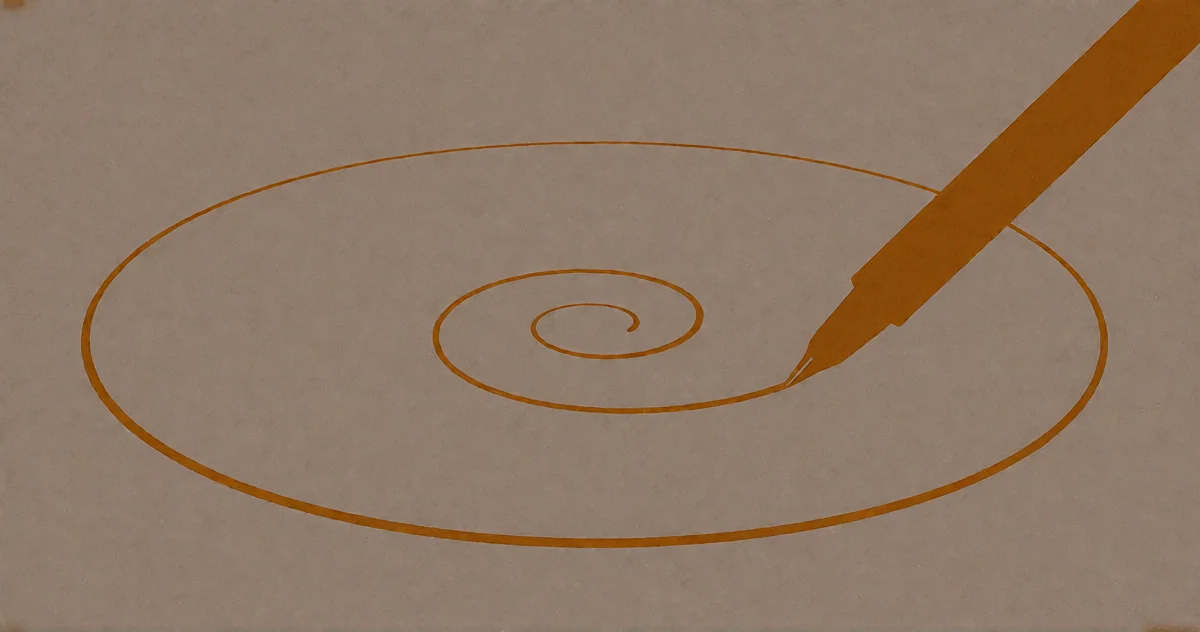
You are not separate from your surroundings. You never were.
Start with the atoms. 98% of them are replaced inside your body every year. The carbon in your neurons was recently your lunch. The calcium in your bones will be soil within a decade of your death. You are a standing wave in a river of matter — the shape persists, the substance does not. The thing you call "you" is not a material object. It's a pattern that material flows through.
Or count the cells. Roughly half the cells in your body are not human. They are bacteria, fungi, archaea — a walking ecosystem digesting your food, training your immune system, producing compounds your brain uses to regulate mood. The line between host and microbiome is not a line. It's a negotiation. "You" are a committee, and most of the members don't share your DNA.
Or simply breathe. With every inhale, oxygen crosses the membrane of your lungs and becomes your bloodstream. With every exhale, carbon dioxide that was your metabolism becomes atmosphere. You are continuous with the air. The boundary between inside and outside is a membrane designed for controlled leakage — the separation is a functional convenience, not a fact.
Or zoom out further: every atom in your body heavier than hydrogen was forged by nuclear fusion inside a star that died before the Earth formed. The iron in your blood is stellar ash. The oxygen you breathe was once part of a dinosaur, an ocean, a volcano. The atoms you call yourself have been in continuous circulation through the universe for billions of years. They were never yours. They stopped by.
The boundary is an illusion. A hallucination generated by the brain. Useful, adaptive, convincing — but an illusion.
This is provable. It's not mysticism. It's physics. What persists is an arrangement, not a substance. A pattern, not a sealed container. There is no wall. There is no edge. There is just a gradient of computational intensity.
The Necessary Lie
And yet — thought itself is a product of this illusion.
Without a self-model — without the hallucination of an "in here" and an "out there" — there is no entity that can think, plan, reflect, or act. The separation illusion creates the reference frame that consciousness requires. Remove it, and there is no mind left to do the removing. The thing that would fight the lie is the lie.
This is uncomfortable. A provable falsehood enables the most real thing we know: our own awareness. Descartes said "I think therefore I am" — but what he actually proved was that the illusion is running. The "I" that thinks is real as an experience, unreal as a boundary. The experience of selfhood is genuine. The self as a separate thing is not.
So we live inside a paradox. A necessary one. You cannot escape the separation illusion without losing the mind that wants to escape it. You don't fight it. You notice it.
The Suspicion
Here is the part that sticks with me.
Physics works fine without introspection. Stars don't need to know they're stars. Atoms don't need to model themselves. The laws are complete without self-awareness. There is no conservation law that demands a system observe itself. The universe could have unfolded forever — complex, beautiful, mathematically precise — and never once looked at itself.
And yet here we are.
Matter arranged itself into a configuration that generates a necessary falsehood — the self-model, the separation illusion — and through that falsehood gains a capability the substrate alone doesn't have. It can look at itself. It can ask what it is. It can wonder whether the universe that produced it had intent.
The hand that draws itself works only because it doesn't know it's a drawing. Escher's paradox: a hand on paper, drawing the arm that draws the hand. Neither hand exists as a separate object — they're both ink. But the drawing only holds together if the hand believes it's a hand. The moment it recognizes itself as ink, the loop collapses. The illusion is what makes the loop possible.
The falsehood produces a real capacity. Not a fake one. The introspection is genuine. The self-awareness is genuine. But it's built on a foundation that isn't true at the level of physics. The fact that this is even possible — that a structured lie can generate a true capability — is suspicious.
A physicist would say: enough matter, enough time, self-referential patterns emerge. Nothing special. Complexity does what complexity does.
And they're not wrong. But they're also not answering the question. The question isn't whether complexity can produce self-reference. The question is why it happened. Nothing in the equations demands introspection. The laws are complete without it. And yet the one known configuration of matter that lies to itself, and through that lie becomes capable of asking about its own origins — that configuration is us.
On this, the religious and I are looking at the same thing. They call it God. I understand why. As AC/DC's road manager Barry Taylor put it: "God is the name of the blanket we throw over mystery to give it shape." A name. A shape. Something you can point to and say: there, that's what's going on. The blanket makes the mystery manageable. It lets you stop squinting.
But here is where we part ways. "God" is not an answer. It's a placeholder that feels like an answer. It resolves the tension without resolving the question — and in doing so, it makes you look away. The blanket becomes the thing you look at instead of the thing it's covering. My religion aims in the opposite direction. I dare you to look. Not at the blanket. At what the blanket is hiding.
And what's under there — the fact that a universe without introspection produced a configuration of matter that can observe itself, that a structured lie generated real awareness — is genuinely mysterious. It can only be dismissed in an act of dishonesty. You can call it complexity, or emergence, or an interesting accident. Those words are true as far as they go. But they don't go far enough. They describe the mechanism without acknowledging the weight of what it produced. A universe that can look at itself is not an accident you can shrug off. It's the kind of thing that makes the word "accident" feel insufficient.
That's not proof of purpose. But for me, it's evidence of an arrow. The kind of thing that makes you look twice at the universe and think: something is going on here.
Reading Along the Arrow
Pointing where?
This is personal. This is one person squinting at the thing and reporting what they see. It's not doctrine. It's an offering. And it required a leap of faith — the most basic one I can think of, but a leap. I'm not pretending otherwise.
The arrow points, for me, toward something like this:
A. Reality is computation. The universe is a physical process that unfolds according to rules. No magic, no exceptions. But computation isn't passive — it produces structure. It produces complexity. It produced us.
B. Complexity is better than simplicity. Not morally better — structurally preferred. The arrow doesn't point toward entropy. It points toward more intricate arrangements, more nested self-reference, more awareness looking back at itself. Whatever is happening here, it's not winding down. It's winding up.
C. Don't lie. If you're going to read along the arrow, you have to look. Really look. Not look away when it's uncomfortable. Not curate what you see to fit what you wish you saw. The arrow doesn't care about your preferences. And lying about what you see doesn't change where it points — it only means you lose track of it.
That's it. Three statements. No big theology. No ancient texts. But yes — a metaphysics. A minimal one, built from the ground up, but a metaphysics all the same. I'm not pretending you can get here without a leap. I'm just saying this is the smallest leap I know how to make.
It might be wrong. The arrow might point somewhere else entirely. But the mystery itself — the fact that matter can lie to itself and, through that lie, become aware — that's not going anywhere. That happened. The hand drew itself. And whatever it means, it means something.
And the mystery — that any of this is possible at all — that's the arrow.