Why the Fuck Not?

Listen to this article

A ladder unfolding into a bridge

Let's aim big.

Equality. Quality of life. Health. Freedom.

Not as the polite residue left over after growth, but as the point of the exercise. Why the fuck not?

The four aims: equality, quality of life, health, and freedom

These are not four independent boxes. By equality I mean equal standing, not identical lives; by freedom, real options and the practical ability to use them. Equality without freedom can become enforced uniformity. Freedom without equality becomes privilege. Health and quality of life give both a body.

AI—or superintelligence, for those who prefer the larger label—opens possibilities that until recently belonged to speculation. Nearly everyone agrees on that part. Yet possibility arrives without an address. It does not tell us whose life will improve, who will own the new capacity, or who will be left with a cheaper subscription and no income.

For whom is all this capability supposed to be?

The answer is often left blank, perhaps by choice. Naming an aim would force us to examine who benefits now, who stands to lose, and whether the people building the future have any intention of sharing it. It is much more comfortable to talk about transformation in the abstract and let the existing distribution of power fill in the details.

I would rather not leave that part to the default settings.

The age of AI can go wrong in horrifying ways: cheaper surveillance, manipulation, coercion, and war; more capability paired with less freedom. If we do not aim at something good, we are not choosing a neutral future. We are simply delegating the aims to whoever already holds the levers.

The objections arrive on schedule: we cannot afford it. Sometimes that is true. Energy, labor, materials, time, and ecological capacity are real constraints. But “we cannot” is a wonderfully versatile phrase. It can describe a law of physics, an empty treasury, a property regime, or the fact that somebody quite likes the current arrangement. These are very different problems, and only the first cannot be wished away.

The ticket to the output

Productivity growth is old news. The potentially new threshold is broad substitution across cognitive work, perhaps followed by wider physical automation, until output can keep rising while economically valuable human labor becomes much less necessary.

That has not happened across the whole economy, and I do not know whether it will. Automation also complements workers and creates new tasks. Still, the possibility matters because our present arrangement rests on a quiet dependency: most people receive their share of the output by selling their labor.

If that mechanism weakens, cheaper goods alone do not settle the matter. A lower price is of limited comfort to an empty wallet.

Production and access are different problems. An economy can develop the capacity to solve the first while failing at the second.
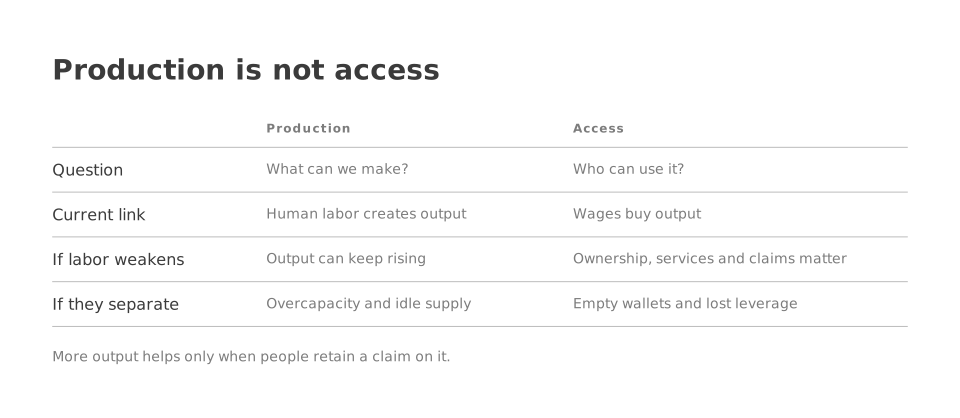
Production answers what we can make; access answers who can use it

Access is not a moral ornament bolted onto the side of production. A market requires customers. If output expands while purchasing power drains away, the economy does not become a glorious abundance machine with an unfortunate blind spot. It gets full warehouses, idle capacity, and a political crisis.

The deeper problem is power. Labor has supplied bargaining power as well as income. If production requires much less human effort, appeals to everyone's better nature will not fill the gap. Ownership, democratic rights, public services, and enforceable claims on output have to be built while the transition is still negotiable.

Show me the limit

Whenever somebody explains why a better arrangement is impossible, the obstacle ought to pass through a small customs inspection. Is it physical, institutional, or positional? “We cannot” crosses the border between these categories with suspiciously little paperwork.

A physical limit can be worked with, within reason. An institutional limit can be redesigned, with effort and friction. A positional limit cannot be abolished by producing more: not everyone can be above average, exclusive, or in command. Yet we can still decide what being above average is allowed to buy.

None of this means institutions change because we glare at them. Capital moves, states compete, and one government acting alone may fail where a coordinated bloc could succeed. “Just change the system” is a slogan, not a policy. It marks where the work begins, not where it ends.

The distinction matters because each kind of limit calls for a different instrument: engineering, institutional redesign, international coordination, or a firm refusal to let social rank determine who gets medicine. Calling every obstacle “realism” merely spares us the trouble of reaching for the right tool.
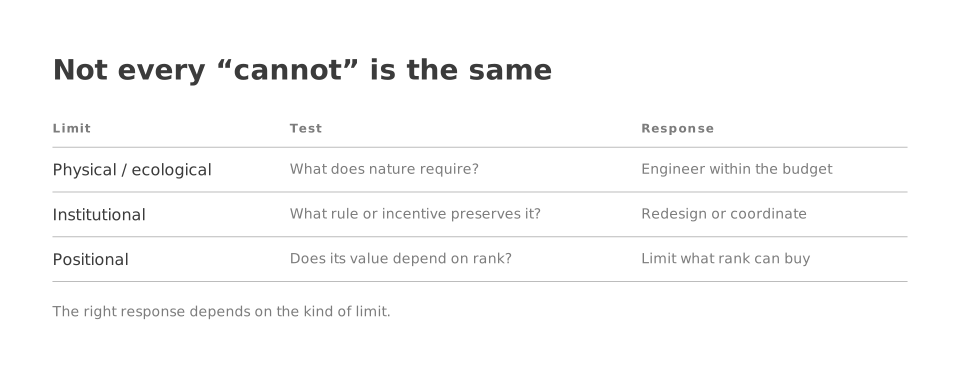
Physical, institutional, and positional limits require different responses

AI has to pass through the same inspection. Behind the weightless interface sit data centers, fabs, power grids, cooling towers, and mineral supply chains. It is heavy industry with a text box. The International Energy Agency estimated that data centers consumed about 415 TWh in 2024, with demand projected to more than double by 2030 in its Base Case. Those figures cover all data centers, not AI alone, which is still more than enough to ruin the pleasant fiction that computation happens in a cloud without weather.

This does not sink the ambition; it specifies the bill of materials. It means clean energy, grid infrastructure, more efficient computation, and hard ecological budgets. If the impact per service falls tenfold while total use rises twentyfold, total impact still doubles. The efficiency chart looks triumphant while the atmosphere gets worse—the sort of improvement we should learn to spot from a greater distance.

Show me the physical constraint. Show me the ecological budget. Show me the unavoidable trade-off. If none exists, do not call the preservation of deprivation “realism.”

The rich can get richer

A standard objection is that the wealthy will never allow a fairer arrangement. Some will not. Still, it is worth being precise about what they would actually be defending.

You can get rich by making other people's lives better. Better medicine, cheaper clean energy, stronger education, and more capable tools create genuine value. Any workable transition will need builders, ambition, and risk-taking. Declaring war on success itself would be spectacularly counterproductive, above all for the people in whose name the war was declared.

Yet wealth creation and wealth capture are distinct trades. Rent extraction and monopoly also produce fortunes. A positive-sum economy is possible, not self-enforcing.

And then there is the problem that growth alone cannot dissolve. Health, security, time, and freedom can be shared without losing their value. Status and command over others are positional. If wealth means living well, other people's progress takes nothing from the table. If wealth means living in a way others cannot, universal improvement registers as a personal injury.

Luxury can remain luxury. What needs limits is domination.

Wanting a good life is not a moral defect. Needing other people to lack one is harder to defend.

What the multiplier is for

Equality, quality of life, health, and freedom are easy to applaud at a conference and expensive to mean on a Tuesday. That is why serious people so often lower their gaze and return to the quarterly targets.

Yet why should the quarterly target have a monopoly on seriousness?

They are vague only if we leave them floating in the abstract. Here they have a test: does a person have standing, a real choice, a healthy life, and the time and security to live it? No law of physics decrees that these material preconditions must remain scarce.

The point of a 10x society is not ten times as much stuff. It is that fewer lives are constrained by deprivation, exhaustion, and preventable illness. The goal is not to make humanity redundant. It is to make human dignity less conditional.

So the next time someone explains why people must remain insecure, exhausted, or untreated, ask to see the ledger rather than the raised eyebrow. If the constraint is physical, let us engineer. If it is institutional, let us redesign. If it is a coordination problem, let us coordinate. And if it turns out to be privilege dressed up as fate, let us at least stop calling it inevitable.

We are discussing a choice about power and access.

Arrangements like that do not yield because an essay asks politely. They shift when people organize, build working alternatives, and make the old settlement too costly to maintain. Still, they remain choices.

Why the fuck not?

Sources

Research Notes: Production, Access, and Labor's Leverage

Productivity is not the same as decoupling

Output per hour has risen throughout economic history without eliminating the demand for human labor. Automation can complement workers, create new tasks, reduce prices, and expand demand.

The stronger possibility addressed by the article is broad substitution across cognitive work, potentially followed by wider physical automation, such that productive capacity rises while economically valuable human labor becomes much less necessary. This is a conditional scenario, not an observed economy-wide conclusion.

Cheap cognition also does not automate every physical process. Housing, food, infrastructure, transport, surgery, and care retain material, biological, logistical, and human-presence constraints.

Wages as an access mechanism

Production determines what an economy can make. Distribution determines who can obtain it.

In the present system, wages provide most households with their main claim on output. If labor income weakens, several adjustment paths remain possible: lower prices, new work, more ownership income, shorter hours, public provision, or transfers. None follows automatically from automation.

Nominal wages, real purchasing power, employment, hours, and ownership income measure different things. An adequate analysis has to keep them separate.

The demand connection

Production and access are analytically distinct, but a market economy links them through demand. If output expands while household purchasing power fails, firms can face overcapacity and falling sales. Distribution therefore affects macroeconomic stability as well as fairness.

Distribution mechanisms and their constraints

Possible responses include broader asset ownership, public or social dividends, universal basic services, taxation and rent capture, and shorter working time. These mechanisms are not interchangeable:

  • A dividend requires an enforceable claim on real output or income.
  • Universal services require productive capacity and a reliable provision mechanism.
  • Shorter working time changes output, income, and the distribution of available work simultaneously.
  • Public ownership changes both claims on returns and decision rights.

Each mechanism needs to be tested against fiscal, administrative, ecological, and coordination constraints. Listing them does not establish feasibility.

Labor's leverage

Labor has supplied bargaining power as well as income. Employers and states have depended on workers, taxpayers, and soldiers; strikes, organization, and democratic pressure have used that dependence to negotiate distribution.

If production needs substantially less labor, that source of leverage can weaken. Positive-sum appeals do not answer the resulting power question. Ownership claims, democratic rights, public services, competition rules, and enforceable entitlements become more important when access to output cannot depend solely on employment.

What this argument does not support

It does not prove that automation must reduce total employment, that new tasks cannot emerge, or that one distribution mechanism is sufficient. It establishes why the access and power questions should be designed for before a transition makes them harder to negotiate.

Research Notes: Physical, Institutional, and Positional Limits

Physical and ecological limits

Energy, materials, time, biological processes, land, and the capacity of ecosystems to absorb damage constrain what can be produced. These limits can change through technology, but they cannot be repealed by ownership rules or political preference.

Efficiency ratios do not replace absolute ecological ceilings. A process can become cleaner per unit while total damage rises through increased use.

Institutional limits

Ownership, intellectual property, wages, market access, professional rules, taxation, and administrative procedures are human arrangements. They can be redesigned, but redesign has transition costs, enforcement requirements, and distributional consequences.

Calling a constraint institutional does not make it imaginary or easy to change. It changes the question from “is this physically possible?” to “what arrangement could work, and how could we get there?”

Relational and positional limits

Some goods depend on relative position: being above average, holding exclusive status, or having more power than another person. These cannot be made universally abundant by increasing production.

The practical response is to limit what positional advantage can determine. Status can affect recognition without deciding access to medicine, basic security, or political standing.

Coordination problems

An institution can persist without being one incumbent's simple preference. Capital mobility, international competition, fragmented authority, and conflicting legitimate interests can prevent a preferred arrangement from being implemented by one actor.

Collective-action problems require coordination mechanisms such as common standards, treaties, shared infrastructure, or enforceable commitments. Identifying an unjust outcome does not by itself supply the mechanism.

Worked example: legal help

AI can reduce the cost of reading, translation, first-pass explanation, and drafting. The remaining constraints are not all of one kind:

  • Technical: reliability, uncertainty detection, and verification.
  • Human and procedural: evidence gathering, court capacity, representation, and enforcement.
  • Institutional: who may provide a service, who is liable, and how access is financed or controlled.

The opportunity is to expand useful assistance while preserving necessary review and responsibility. “AI replaces lawyers” and “no legal workflow can change” both skip this analysis.

What this method does not support

It does not prove that every claimed institutional obstacle is an excuse, that every positional desire is illegitimate, or that physical feasibility establishes a workable transition. It requires each claim to identify its mechanism before it can veto the ambition.

Research Notes: AI's Energy Budget

Electricity demand

The International Energy Agency's Energy and AI report estimated global data-center electricity consumption at approximately 415 TWh in 2024, around 1.5% of global electricity use.

Its Base Case projected approximately 945 TWh by 2030, just under 3% of projected global electricity consumption. The report's 2030 scenarios ranged from about 670 TWh in the Headwinds Case to 1,260 TWh in the Lift-Off Case, with a High Efficiency Case around 800 TWh.

These figures describe data centers as a whole, not AI alone. The report identifies AI as the most important driver of growth alongside other digital services. Accelerated-server electricity use, driven mainly by AI adoption, was projected to grow faster than conventional-server use.

Infrastructure constraints

The IEA described grid congestion, connection queues, and stretched supply chains for equipment including transformers and gas turbines. It estimated that around 20% of projected data-center additions by 2030 in the Base Case could be at risk of delay.

This makes the constraint local and temporal as well as global. Total annual electricity statistics do not establish that generation, grids, equipment, and permits can reach a particular cluster when required.

Rebound and absolute impact

Price and environmental impact are different quantities. If impact per service falls tenfold while service use rises twentyfold, total impact doubles. If the energy source and material intensity change, a different result is possible; the mechanism has to be measured in physical units.

For rival goods, expanded access also expands consumption. Access to surgery, housing, transport, and staffed education consumes resources. Information and other low-throughput services have different scaling properties, but they are not impact-free.

A serious accounting therefore needs several measures rather than one efficiency ratio: absolute ecological ceilings, energy and material throughput, access to capabilities, distribution, and labor or time requirements.

What these figures do not support

They do not show that AI alone consumed 415 TWh in 2024, that a 10x economy must use ten times as much electricity, or that data-center growth makes expanded digital capability impossible. They establish a physical infrastructure requirement and a scenario range, not a verdict on the ambition.

Sources

  • International Energy Agency, Energy and AI, April 2025, especially the Executive Summary and Chapter 2, “Energy for AI.” Figures checked against the report PDF.

Research Notes: Progress, Wealth, and Power

Broad long-run improvement

Steven Pinker's The Better Angels of Our Nature and Enlightenment Now assemble evidence for long-run improvements across dimensions including violence, health, longevity, poverty, literacy, and material capability.

The relevant use is narrower than “everything got better for everyone.” Long-run improvement can coexist with reversals, unequal outcomes, environmental costs, and substantial private wealth. Pinker's books are not evidence that every form of wealth creation benefits everyone.

Inequality did not move in one direction

The World Inequality Report's long-run series show top income shares declining through much of the middle of the twentieth century and rising again after 1980. The timing and magnitude vary by country and by whether income or wealth is measured.

Broad progress therefore cannot be used to claim that concentration rose uniformly while everyone's life improved. It has coincided with both compression and renewed concentration. Public investment, organized political struggle, redistribution, and changing rules helped shape those outcomes alongside invention and markets.

Positive-sum and extractive wealth

Wealth can be created by expanding useful capabilities: better health, cheaper clean energy, improved education, infrastructure, and services. This supports a positive-sum offer in which builders and investors prosper by improving other people's lives.

Wealth can also be captured through monopoly rents, restricted access, externalized environmental damage, land scarcity, or political privilege. The availability of a positive-sum path does not establish that it is the default or that every fortune satisfies it.

Absolute capability and positional advantage

Health, security, time, and practical freedom can improve for one person without requiring another person to have less. Status and power over others are relational: not everyone can occupy the top position or dominate everyone else.

Additional income can continue to improve aspects of well-being, although its marginal effect varies. The important distinction is not a claimed plateau in happiness but the difference between reproducible capabilities and advantages whose value depends on comparison or control.

Luxury also is not automatically separable from ecological allocation. Some luxuries use scarce land, energy, materials, or human attention and therefore compete with other uses. The boundary between acceptable luxury and harmful domination requires ecological budgets and institutions that limit the conversion of wealth into political control.

What this argument does not support

It does not establish that wealth is inherently illegitimate, that all progress depended on markets alone, that redistribution never mattered, or that status competition can be eliminated. It supports a narrower claim: becoming rich by expanding human capability is possible, while access to basic dignity need not depend on relative rank.

Sources

  • Steven Pinker, The Better Angels of Our Nature: Why Violence Has Declined (2011).
  • Steven Pinker, Enlightenment Now: The Case for Reason, Science, Humanism, and Progress (2018).
  • World Inequality Lab, World Inequality Report 2026: Global Economic Inequality (2026), long-run income-share series.

↓ Markdown