AI Slop Is Not the Fast Food of Music. Genre Music Is.
Listen to this article
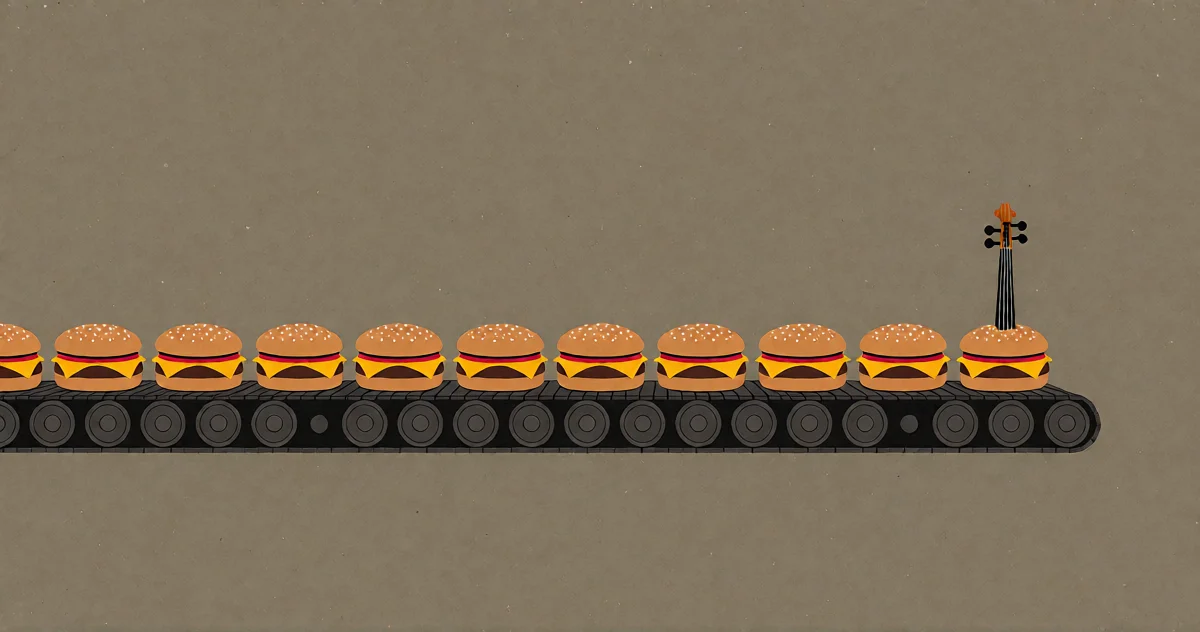
My son calls almost every tune he hears that stays firmly within its genre — pop, EDM, funk — "AI slop." He means it as an insult. The analogy is obvious: AI music is like fast food. Cheap, mass-produced, nutritionally void.
He's wrong. But not in the way you think.
The Correction
Genre-conforming music was always fast food. Long before AI could produce it. A perfectly constructed pop song, a by-the-numbers EDM drop, a funk track that hits every expected beat — these are cheeseburgers. They serve a specific need without fuss. You know what you're getting. That's the point.
What changed isn't the product. What changed is who's making it.
AI is very good at making fast food. In fact, AI is better at it than most humans. A music producer with deep knowledge of a genre's zeitgeist can craft something that fits. AI can do the same thing faster, with less ego, and with an encyclopedic recall of every production trick that has ever worked in that genre. It doesn't get bored. It doesn't try to show off. It just delivers.
If you're in the business of making genre music, AI is not your replacement. It's your competition. And it's winning on volume, speed, and consistency.
Why AI Wins at the Body
This isn't a creativity problem. It's a distribution problem.
AI models are trained on what exists. They learn the central tendency — the patterns, the conventions, the "where the data clots." That clot sits at the body of the distribution: the center of the bell curve where most music lives. AI is phenomenal at producing things that belong to that center. It completes patterns. It fills in the expected next note, the expected chord change, the expected mix balance.
Most people want the center. They want music that feels familiar. They want to know what's coming. The popularity of genre music is not a failure of taste — it's a success of function. Music that stays firmly within the rails delivers exactly what the listener came for. It's comfort food. It's a cheeseburger.
AI makes excellent cheeseburgers.
Where Humans Still Cook
The interesting question is: what's the cuisine of music?
Technically, anything that's adventurous. It happens in every genre at the fringes of what the genre will tolerate. A production choice that's slightly wrong for the form but works anyway. A harmonic turn that shouldn't resolve but does. A structure that almost breaks the contract with the listener and then, at the last moment, honors it.
This is what I call the "adjacently unknown" — it's one step beyond what the genre expects, but not so far that it loses the listener. It's the difference between a cheeseburger and a dish that tastes like a cheeseburger but isn't one.
AI is bad at this. Not because AI can't be creative, but because the adjacently unknown is not a pattern. It's a departure from the pattern that still lands. It requires understanding not just what the data says, but what the listener almost expects and then doesn't quite get. Training data doesn't teach you where the edge is — it teaches you where the center is.
The Art of Smuggling
If you're a musician who wants an audience, you face a contradiction. The market wants cheeseburgers. You want to cook. The resolution is not to choose one or the other. It's to smuggle.
You deliver what the market requires — the familiar shape, the expected structure, the comfort of genre. And then you put something in the pocket that the listener didn't anticipate. A tiny adventure. A moment where the song almost goes somewhere else. You give them the cheeseburger, but the sauce is wrong in a way they can't quite name.
This is what professional musicians have always done. The great pop producers are not the ones who reinvent the form — they're the ones who deliver the form so perfectly that you don't notice the one bar where they broke it.
AI will be bad at smuggling for quite a while. Smuggling requires knowing which rules to break and knowing that breaking them is an act of deliberate transgression against a form you fully command. AI doesn't know it's breaking rules. It doesn't know there are rules at all.
The Edge-Lords: Tomorrow's Clichés
And then there's the music that nobody wants.
The rebels. The edge-lords. The experiments that make no sense to anyone except musicians, producers, and the small handful of trendsetters who get high on novelty. This music has no audience. It fails most of the time. When it succeeds, it doesn't sound like music yet — it sounds like noise that might, someday, with enough refinement, become a genre.
AI is terrible at this. By definition, there is no training data for the unmapped edge. The edge hasn't been recorded yet. It hasn't been analyzed or categorized or turned into a Spotify playlist. It's happening in a basement in Berlin right now, and in six years it'll be in a car commercial, and in twelve years AI will be able to produce it flawlessly.
The edge-lords are the seed bank. Dubstep was edge-lord music. Industrial was edge-lord music. Auto-Tune as an effect instead of a correction tool was an edge-lord move. Every genre convention that AI now reproduces perfectly was once an act of rebellion against a previous set of conventions.
The pipeline runs like this: humans explore the edge → the edge calcifies into a genre → the genre becomes popular → AI learns to produce the genre → AI makes better cheeseburgers than humans.
AI is not the enemy of musical progress. AI is the efficient manufacturing plant for whatever was invented ten years ago.
Why We Still Need Humans
We need humans because someone has to invent tomorrow's clichés.
We need musicians who will spend years making music that almost no one listens to, finding the tiny fractures in the current form where something new can grow. We need producers who understand the zeitgeist well enough to smuggle the adjacently unknown into the body of the familiar. We need the edge-lords whose experiments will fail 99 times and succeed once, and that one success will become the training data for the next generation of AI.
AI can make the cheeseburgers. And that's fine — most people want cheeseburgers, and AI makes them better than we ever could.
But someone has to invent the cheeseburger first.