The Rupture
Listen to this article
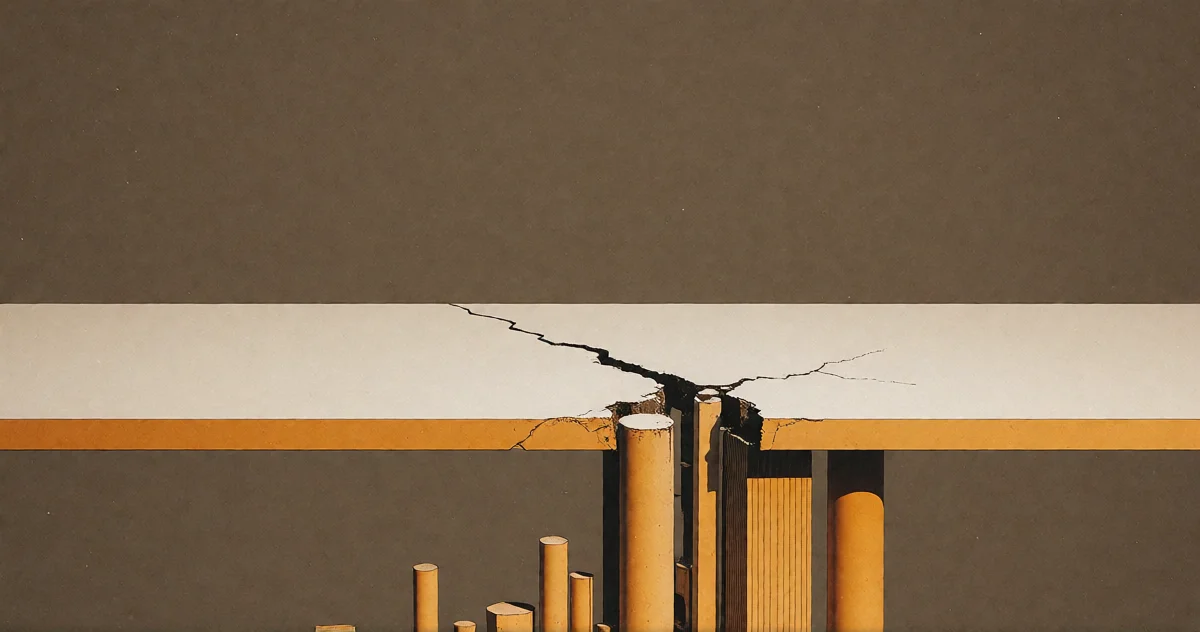
Intelligence is distributed unevenly, and we have a standing agreement not to talk about it.
The difference between the bottom and the top of the distribution is not subtle. It's the difference between struggling with written instructions and inventing new fields of mathematics. Most of us cluster in the middle, and the middle is where the agreement lives: we tell ourselves outcomes are about effort, opportunity, applying yourself. They mostly aren't. The education system is a filter, not a solution — it finds the people who were already going to succeed and certifies them.
Even among "the smart ones" we keep no categories. A single bucket spans from competent professional to once-in-a-generation, and the system doesn't track the difference, because tracking it would force questions about who should do what — questions we don't want to answer.
I notice the blind spots because I've seen the system from outside. When someone close to you is neurodivergent, or when your own mind doesn't run the standard operating system, you learn where the edges are. Intelligence is real. It's distributed. It isn't fair. And nobody wants to talk about it, because the conversation leads places.
AI is about to force it anyway.
AI doesn't create the inequality of intelligence. It removes our ability to keep ignoring it — and what we build after that admission is the only question that matters.
The Next Domino
Companies are racing to automate, and the pitch is efficiency. The reality is that someone gets fired. But who? The people making that call are not equipped to make it. CEOs have other qualities — vision, charisma, political instinct; evaluating the cognitive contribution of their own staff is not among them. And HR optimizes for cultural fit, for social fluency, for the appearance of competence. The genuinely brilliant person who can't make eye contact in meetings has been getting weeded out for decades. The system selects against capability when capability doesn't come in a socially acceptable package.
So when AI makes half the workforce redundant, the decision about who stays won't be made by people who can identify talent. It will be made by people who can identify people like themselves. And people like themselves — middle management — are precisely the group AI replaces first.
The Dark Path
Middle management was our answer to the first wave of automation. When machines replaced hands, we needed people to coordinate the machines. AI doesn't need coordinators. It needs prompts. The comfortable, status-conscious, well-networked middle is the next domino: expensive, non-producing, doing exactly the thing an LLM does better.
But it has access, and institutional muscle, and it will not go quietly. It will run to legislation — demand that AI be regulated, slowed, controlled — and it will wrap self-preservation in the language of worker protection and ethics.
In a global economy, regulation is a Maginot Line. You can build it; the competition walks around it. Countries that don't regulate will outcompete countries that do. The managers legislating to protect their positions will accelerate the decline of the economies they're trying to save.
The dark path: inequality gets worse, but it hits different people. The old elite gets disrupted. A new elite — cognitive capacity amplified by AI — pulls away. And the comfortable middle, the "I did everything right" middle, falls through.
The Bright Path
I don't believe the rupture is a mistake. In a deterministic universe it's the necessary next frame — which doesn't shorten the corridor, but it does forbid despair. Because the bright possibility is real: the rupture may be big enough to force the conversation capitalism has dodged since industrialization.
If AI produces so much value that a fraction of it could sustain everyone at a decent level, the moral case for "you must work to eat" collapses. Not because we become more compassionate — because the math stops working. You can't justify forcing people into jobs that don't need doing when the alternative is affordable and the people being forced have votes.
The answer, I think, looks like Germany's Soziale Marktwirtschaft — the social market economy — stripped of the moralizing. Basic income as dividend, not charity. Everyone gets enough to live decently. No work requirement, no shame attached. Work becomes something people do because they want to — for status, for money, for purpose, for something to do. The incentives stay: want more, work for more. But the baseline isn't survival. The baseline is dignity.
We're about to produce more value with fewer people than at any point in human history. If we can't distribute it so that everyone benefits, the problem isn't the technology. The problem is that we never learned to share.
The Walk Through the Dark
Even the bright path has a dark corridor, and I won't pretend otherwise.
Before any of that arrives, people lose jobs. People lose status. People who spent thirty years climbing a ladder discover it was leaning against the wrong wall. The managers who ran to legislation lose anyway, because economics doesn't care about their feelings. And the people at the bottom — the ones the system already failed — get hit hardest of all.
I don't have a solution for the corridor. I hope someone does. But acknowledging it is better than pretending we can skip it. The bright path isn't a prediction; it's a direction — and the direction is a world where intelligence is finally recognized for what it is: a distribution, not a moral failing. A system that works for everyone on the curve, not just the middle.
The conversation starts when the pretending stops. It's starting.